
Robot Work Envelope Calculator for Workspace Feasibility
Synopsis
A robot work envelope calculator helps engineering teams verify whether a candidate manipulator can service all required task points with acceptable orientation and clearance. This page outlines a repeatable process to estimate effective workspace coverage before committing to cell hardware. With URDFviewer, teams can inspect robot kinematics in a browser, define task regions, and evaluate feasible versus infeasible positions in minutes. The approach is useful for integrators planning assembly, machine tending, or pallet transfer stations where base placement and obstacle geometry strongly affect final performance. By quantifying work envelope limits early, teams can avoid late-stage redesign, reduce commissioning delays, and improve confidence in robot and layout selection.
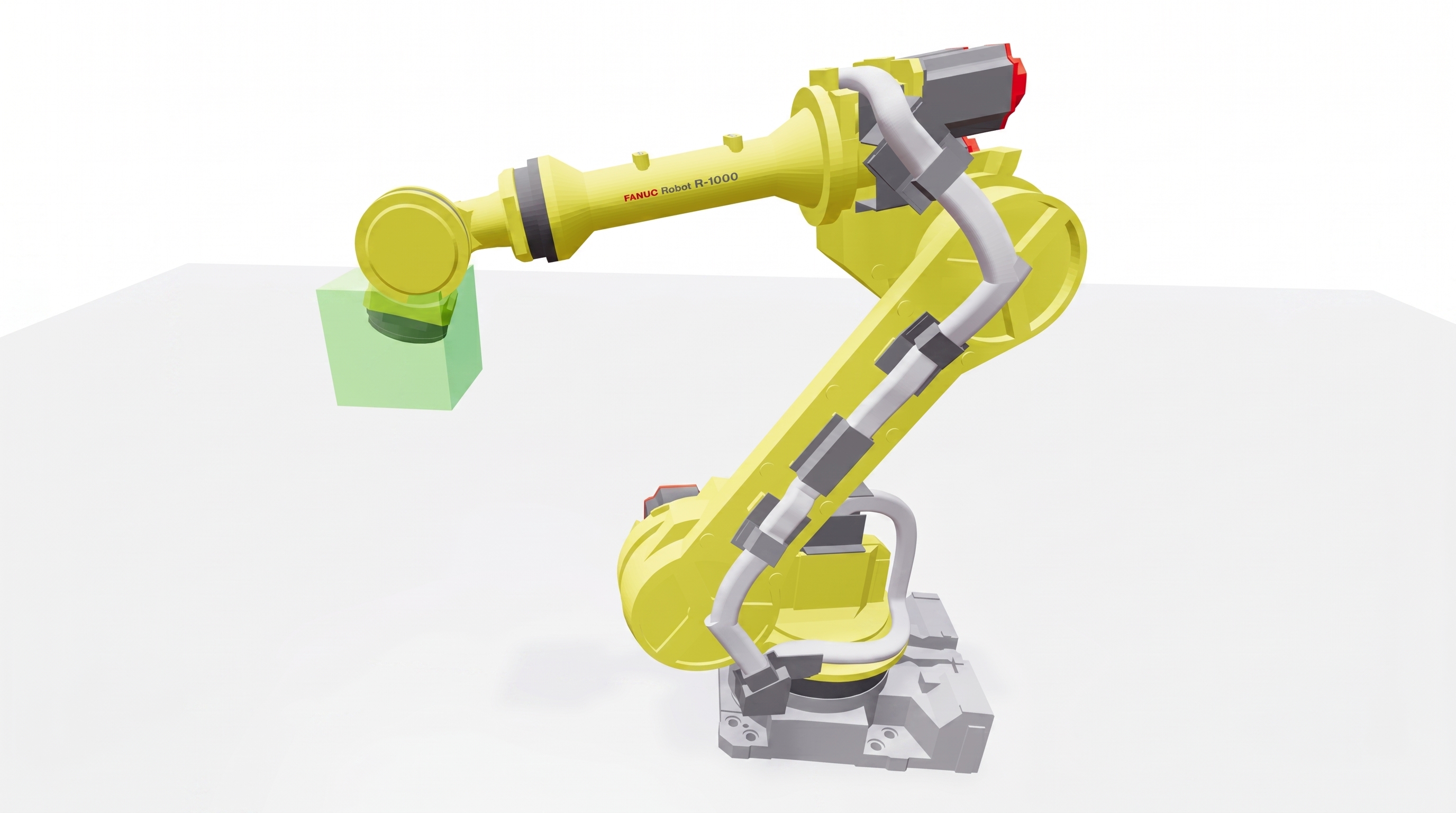
Effective Envelope vs Nominal Reach
Datasheet reach is not enough for layout decisions. A practical work envelope must include:
- Joint-limit effects across full motion range.
- Orientation constraints at the end-effector.
- Clearance constraints from fixtures, tables, and guarding.
- Application-specific entry paths for tools and parts.
The result is an effective envelope that is usually smaller than nominal kinematic reach.
Calculator Inputs You Should Define
Before running analysis, define inputs clearly:
- Robot model and mounting height.
- Tool center point and tool length.
- Required task poses and orientation tolerances.
- Obstacles and no-go volumes in the cell.
For teams using URDF, these parameters can be validated quickly in a model-based workflow.
Fast Validation Procedure
Use this procedure for rapid feasibility:
- Set robot base candidate locations.
- Place task-region volumes for all process steps.
- Run reachability and collision analysis.
- Compare coverage percentage across base candidates.
- Select the geometry with highest feasible coverage and acceptable safety margins.
This gives a measurable basis for layout approval instead of trial-and-error on the shop floor.
Metrics Worth Tracking
Track the same metrics across projects to improve design quality:
- Feasible pose ratio per task region.
- Minimum clearance during transfer motions.
- Number of unreachable points per region.
- Sensitivity to base-offset changes.
Consistent metrics also make design reviews faster across mechanical, controls, and operations teams.
Need a Work Envelope Review
If you want engineering support on envelope validation and robot placement, contact Black Coffee Robotics. We help teams translate workspace constraints into deployable robotic cell designs.